
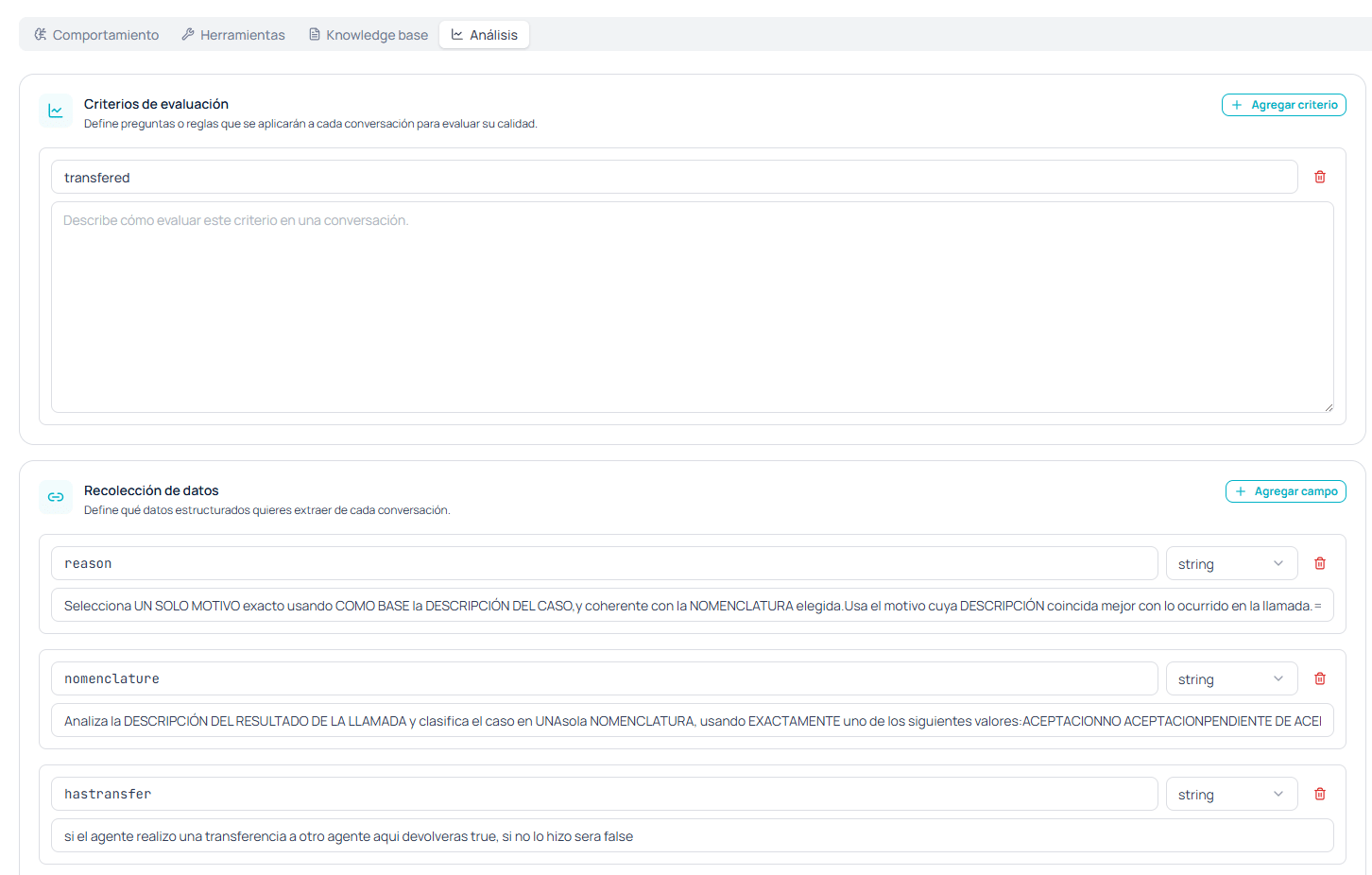
Analysis tab with evaluation criteria and data collection
Evaluation criteria
These are questions or rules applied to every conversation to evaluate its quality. You add them with + Add criterion and each one has two parts:- A name that identifies it.
- A description explaining how to evaluate that criterion in a conversation.
Data collection
Defines what structured data you want to extract from every conversation. You add fields with + Add field and each one has three parts:
This is the piece that turns calls into something your operation can measure and automate: the reason for contact, the classification of the outcome, whether there was a transfer, whether the customer accepted the offer.
How to write a field description
The description works as an extraction prompt, and its precision determines the quality of the data. Constrain the possible values when the field is a classification. If you expect one of five categories, list exactly those five in the description. A classification field with open instructions returns variants you can’t group afterward. Say what to do when the data isn’t there. If the conversation was cut off before reaching the topic, the field needs a predictable value instead of an invention. One field, one piece of data. If you find yourself describing two things in the same field, split it in two.How the results get used
What you define here is evaluated when each call closes and stays attached to it, alongside its recording and transcript. If you register a webhook, the end-of-call event is the natural point to move this data into your CRM or data warehouse.It pays to start with few fields and add more as you learn what questions your operation actually asks. A collection of twenty fields defined up front usually ends with half unused and the other half poorly specified.