
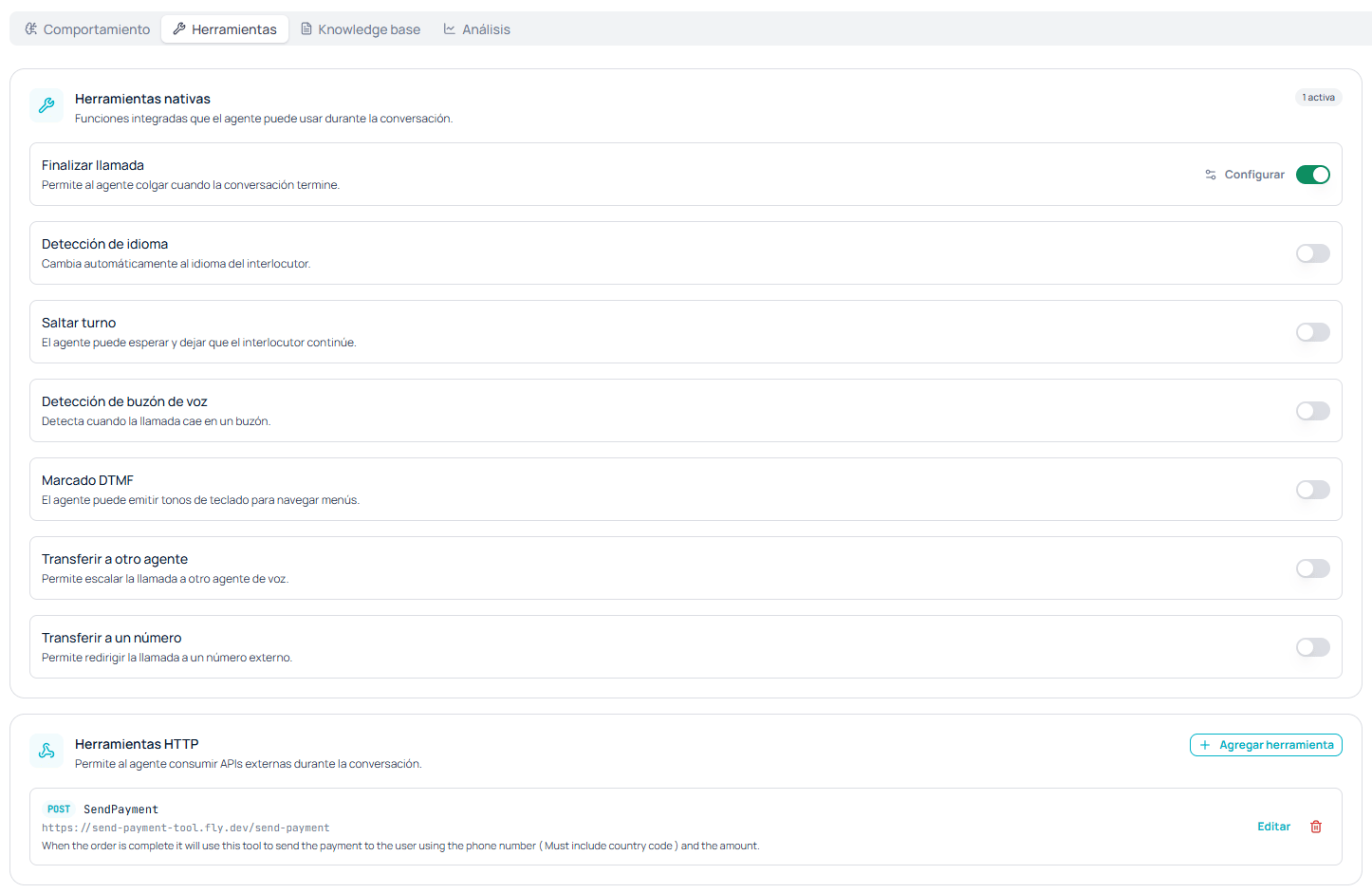
Tools tab with native functions and HTTP tools
Native tools
These are built-in functions the agent can use during the conversation. Each one is an independent toggle, and the corner of the section shows how many you have active.End call also has a Configure option next to its toggle, to tune its behavior in more detail.
When to enable each one
End call is the one you’ll almost always want on: without it the agent has no way to close and the call stays open until the maximum duration limit. Voicemail detection saves the most credits on outbound campaigns. Without it, a call that lands on voicemail becomes the agent talking to a recorder until the time runs out. Skip turn helps when the person speaks slowly or takes long pauses to think; without it the agent tends to interrupt or fill the silence. DTMF dialing only makes sense if the agent will have to get through an automated phone menu, for example when transferring to a switchboard that asks for an extension. Language detection is worth it only if you genuinely expect callers in several languages. If your operation is monolingual, leaving it off keeps the agent from switching languages over a transcription misunderstanding.HTTP tools
These let the agent consume external APIs during the conversation: check a balance, validate a document, record an order, or trigger a payment without leaving the call. The section lists the ones you already have, showing the method, the name, the URL, and the description, with actions to edit or delete them. You create them with + Add tool.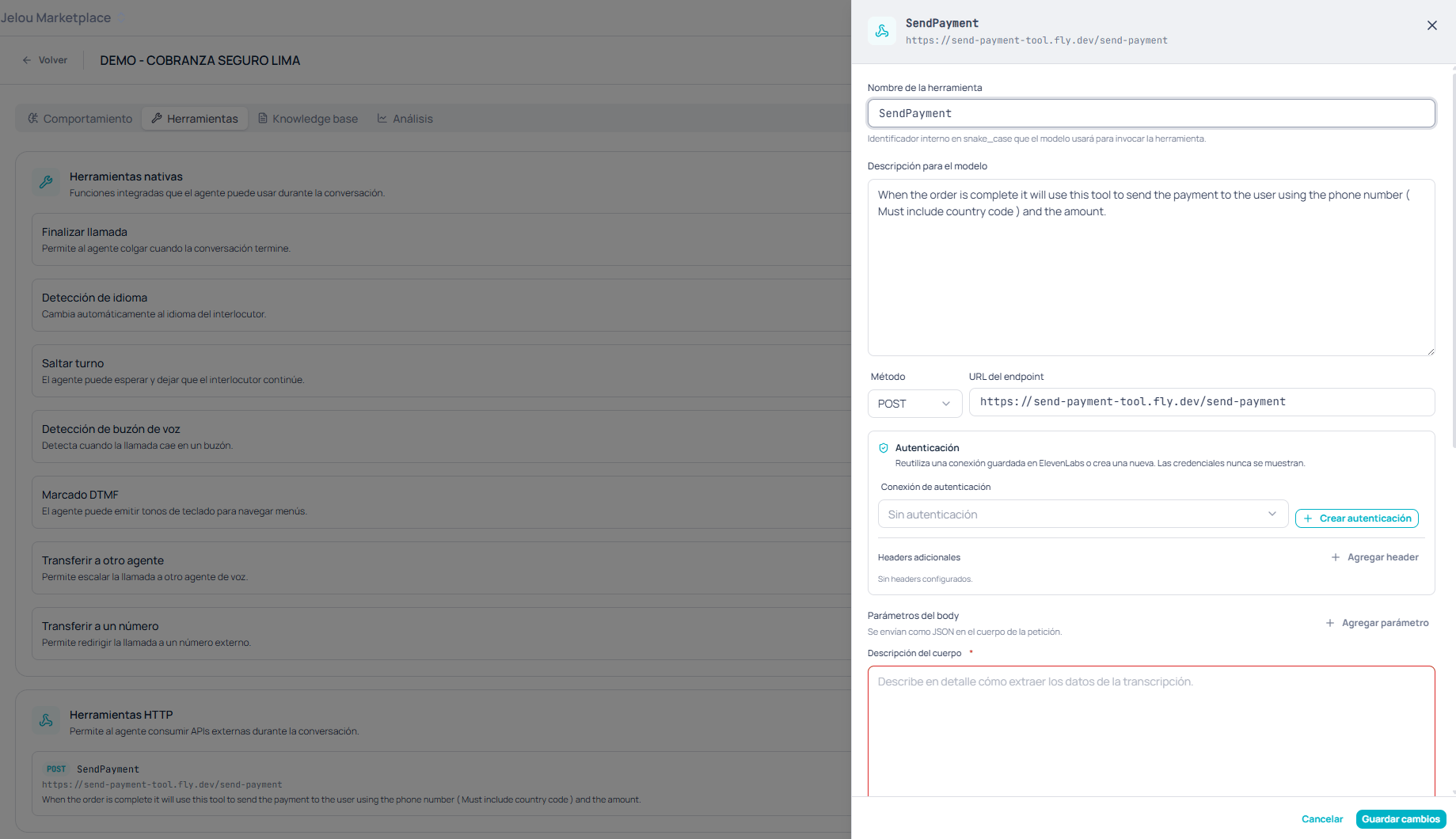
HTTP tool configuration panel
The fields
1
Tool name
The internal identifier in snake_case the model will use to invoke the tool. It’s not text the user hears; it’s the name the agent calls it by.
2
Description for the model
Explains when the tool should be used. This text is all the model has to decide whether to invoke it, so it pays to state explicitly which situation it applies to and what data it needs.
3
Method and endpoint URL
The HTTP verb and the address Jelou will send the request to.
4
Authentication
Reuse a connection saved in ElevenLabs or create a new one with Create authentication. Credentials are never shown once saved.
5
Additional headers
Extra headers sent with every request, if your API needs them.
6
Body parameters
Sent as JSON in the request body.
7
Body description
A required field. Describe in detail how to extract the data from the transcript to build the request body.
Next step
Knowledge base
For frequently asked questions, a document usually beats a call to your API.
Analysis
Define what you want to evaluate and extract from every conversation.