A campaign places outbound calls over a set of contacts with a given agent. It’s how you cover proactive cases — confirmations, reminders, surveys, collections — without dialing one by one. They’re in the Campaigns tab of Voice, and you create them with + Create campaign.

The campaign list

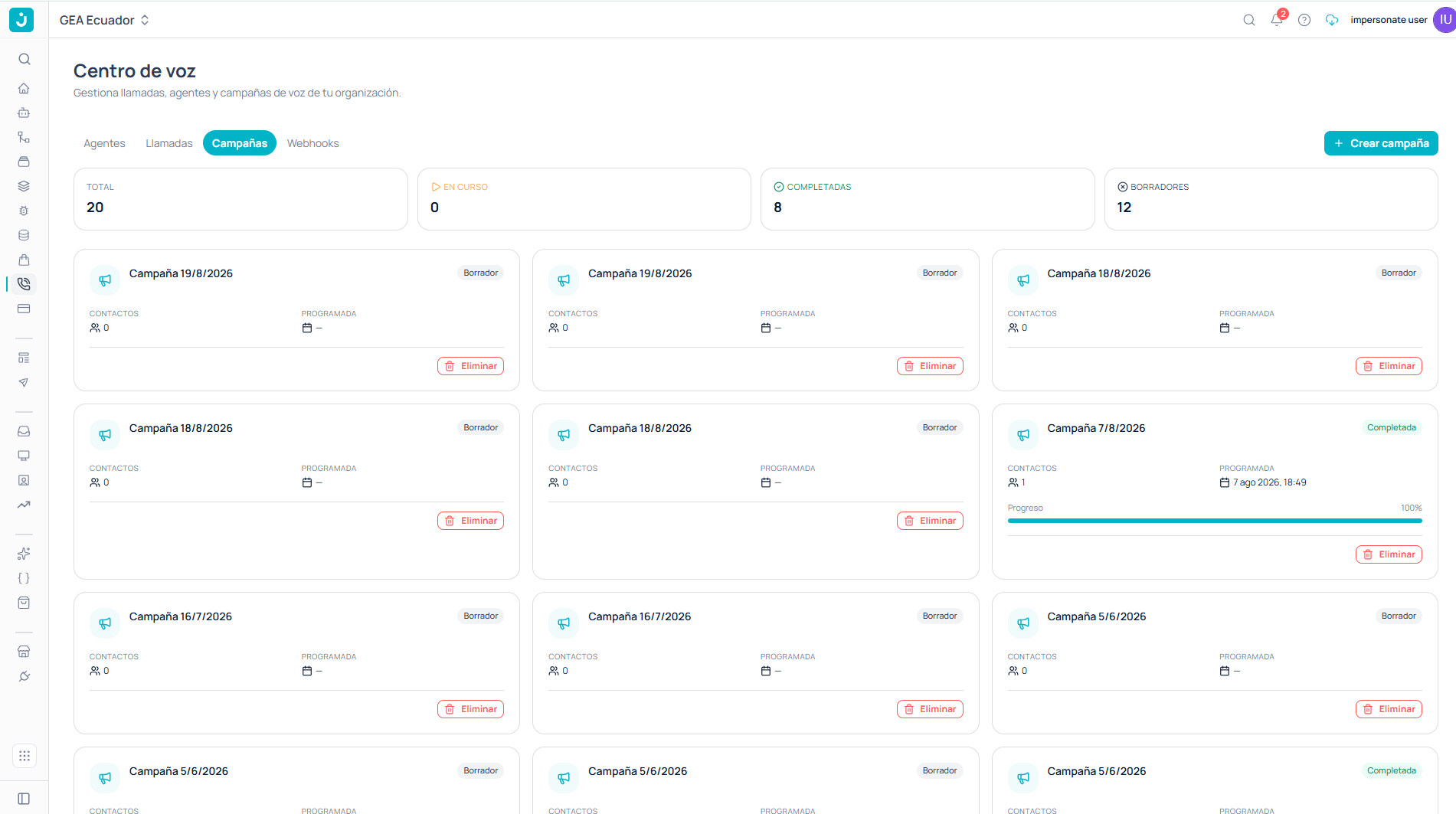
Campaigns view with the Total, In progress, Completed, and Drafts counters, and a grid of cards showing status, contacts, scheduled date, and progress

Campaigns tab with the counters and campaign cards

At the top, four counters summarize the state of your campaigns: Total, In progress, Completed, and Drafts. Below them, each campaign appears as a card with its name, a status badge, how many contacts it includes, the scheduled date — or a dash if it has none — and a Delete button. Campaigns that already started also show a progress bar with their percentage.

A campaign’s states

The drafts counter reveals the most important thing to understand: creating a campaign does not start it dialing.

Draft

Created but inactive. It dials nothing. You can review and fix it without pressure.

In progress

Dialing. From here real calls go out and credits are consumed.

Completed

It finished working through its contacts.

The campaign editor

Opening a campaign takes you into its editor. Everything is configured on a single screen, and the Launch campaign button at the top right is what sets it dialing.
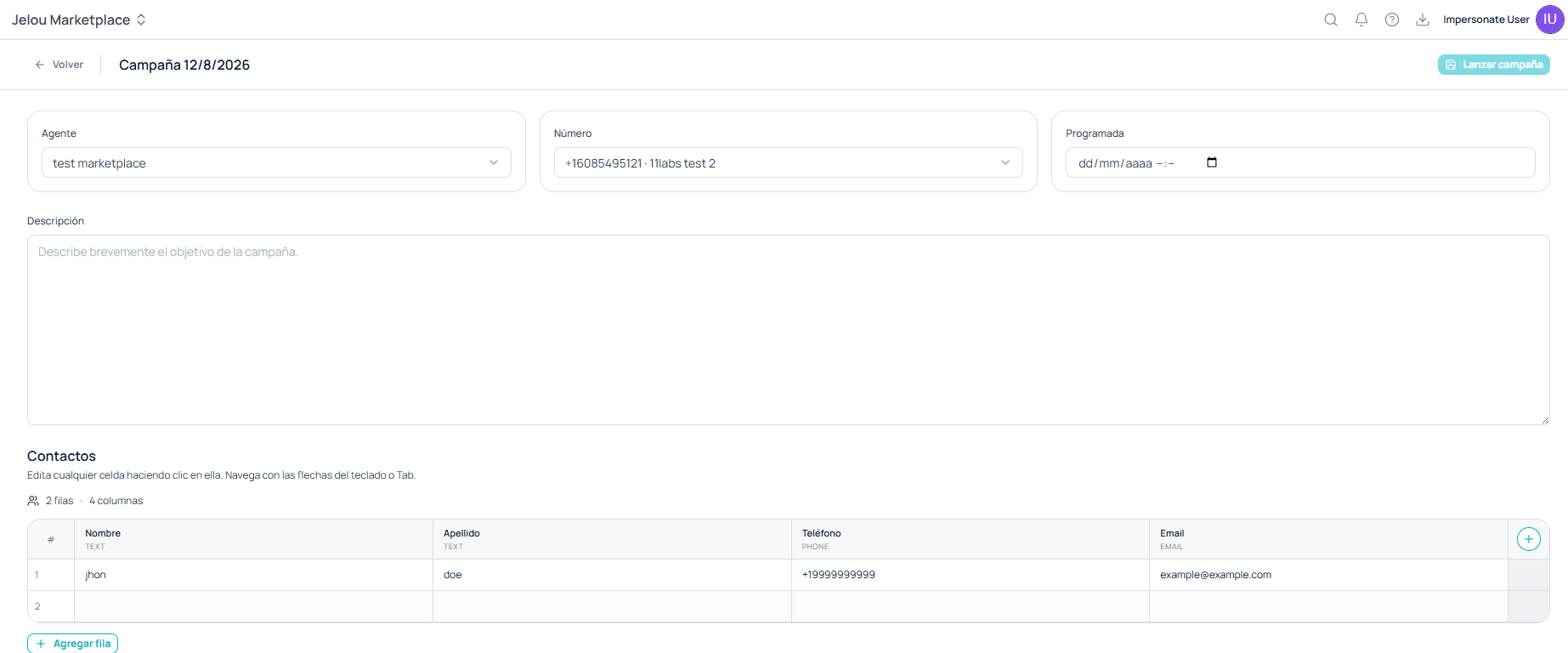
Campaign editor showing the Agent, Number, and Scheduled selectors, the Description field, and the editable Contacts table with the Name, Last name, Phone, and Email columns

Campaign editor with its three selectors, the description, and the contact table

The three selectors

The Number dropdown lists the numbers from your ElevenLabs channels. If it’s empty, you haven’t provisioned one yet: see Numbers and the ElevenLabs channel.

Description

A free-text field to briefly describe the campaign’s goal. It doesn’t affect the agent’s behavior — it’s so your team knows what the campaign is about when they see it in the list.
It’s worth filling in. In an organization with dozens of campaigns named after their date, the description is the only thing that tells one from another when you come back weeks later.

Contacts

Contacts are edited directly in the campaign, in a table that behaves like a spreadsheet: you click any cell to edit it and navigate with the arrow keys or Tab. The header shows how many rows and columns the table has. Columns carry an associated type, visible under their name: + Add row appends contacts at the end, and the + button at the far right of the header adds new columns.
The phone must be in international format, with the + sign and the country code. A malformed number causes a failed call that still consumes the attempt.
Since the table behaves like a spreadsheet, you can prepare your contacts in Excel or Sheets and paste them in rather than typing them one by one.

Launching the campaign

Once the agent, the number, the date, and the contacts are set, Launch campaign puts it to work.
Launching a campaign starts dialing real numbers and consumes credits. Check the row count of the contact table before launching.

Control during execution

The campaigns screen lets you create, edit, launch, and track them. For fine-grained control while they dial — pausing, resuming, cancelling, reviewing the detail of the calls a campaign placed, or testing against a single contact before launching — the CLI covers the full cycle.

jelou voice schedules

Create, activate, watch dialing progress, list the calls placed, pause, resume, and cancel a campaign from the terminal.
The CLI also works with reusable contact lists (jelou voice contacts lists), which can be built from a CSV or XLSX file and targeted from several campaigns. It’s the alternative to the editor’s table when you handle large or repeated bases.

Best practices

Start with a few rows of internal contacts. Validating the greeting, the flow, and your tools’ responses with five calls costs little; discovering a mistake after calling a thousand contacts costs far more. Mind the scheduled time. Calling outside reasonable hours lowers your answer rate and hurts how your brand is perceived. Enable voicemail detection on the agent. On outbound campaigns it’s the difference between hanging up when a recorder is detected and burning the full call time talking to a voicemail. See Agent tools. One campaign, one goal. The agent’s message should match the reason for the call; reusing the same agent across campaigns with different purposes produces conversations that don’t fit. Review the results in the call log. Every call from the campaign lands there with its recording and transcript. See Call log.