
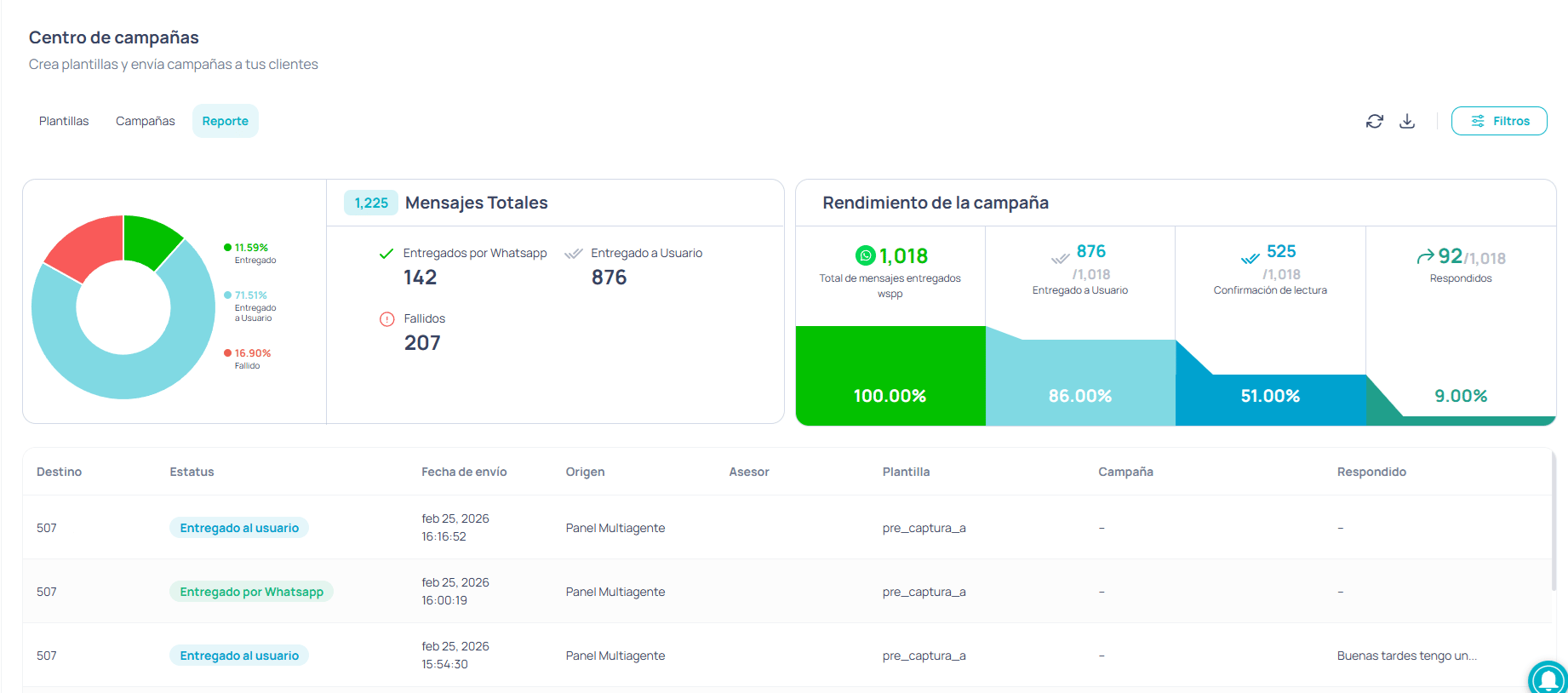
Delivered vs Delivered to user
Message delivered
Indicates that WhatsApp accepted the message correctly. This is a technical validation: the send went through successfully from your account.Message delivered to user
Confirms that the message reached the user’s inbox. If this number is low, it may indicate:- Invalid numbers
- Users without an active WhatsApp
- Restrictions due to quality or behavior perceived as spam
If the difference between “delivered” and “delivered to user” is high, review the quality of your database.
Read receipt
Read
Recorded only if the user has read receipts enabled (blue checkmarks). Should not be used as the main metric. Many users disable this option, so it is not an absolute indicator.Replied messages: the key metric
This is the most relevant metric. It counts the user’s first interaction, including:- Text replies
- Button clicks that activate internal flows
Does not include clicks on external buttons (for example, links to web pages).
- Real interest
- Message clarity
- Effectiveness of the call to action (CTA)
How to read results together
Do not analyze each metric separately. Look for patterns. High delivered + low repliedThe message arrived, but did not generate interest.
Review the content or the CTA. High delivered + high replied
Message and action are aligned.
The campaign worked. Low overall delivery
Review the contact list or the template status.
Recommended next steps
After each campaign:- Adjust the text or the CTA
- Test different message versions
- Optimize buttons and calls to action
- Replicate what worked best