
Add the node to Canvas
1
Open your flow in Canvas
Open in Brain Studio the flow where you want to add Payphone payments.
2
Add the Payphone node
Add Payphone from the Canvas toolbar, the Payments node, or from available payment providers once the integration is installed.The exact location may vary depending on whether you started installation from Marketplace, Jelou Agent, the payments node in Canvas, or a template.
3
Connect the node at the charge point
Connect the Payphone node after the flow already has the amount, buyer data, and purchase confirmation.
4
Open the configuration panel
Select the node to open the right-side panel. Complete the Payment data and Advanced tabs, and review the outputs available on the Canvas node.If required fields are missing, the node shows Incomplete configuration. Check the node fields. and the environment badge (Development or Production).
Configure the node
- Payment data
- Advanced
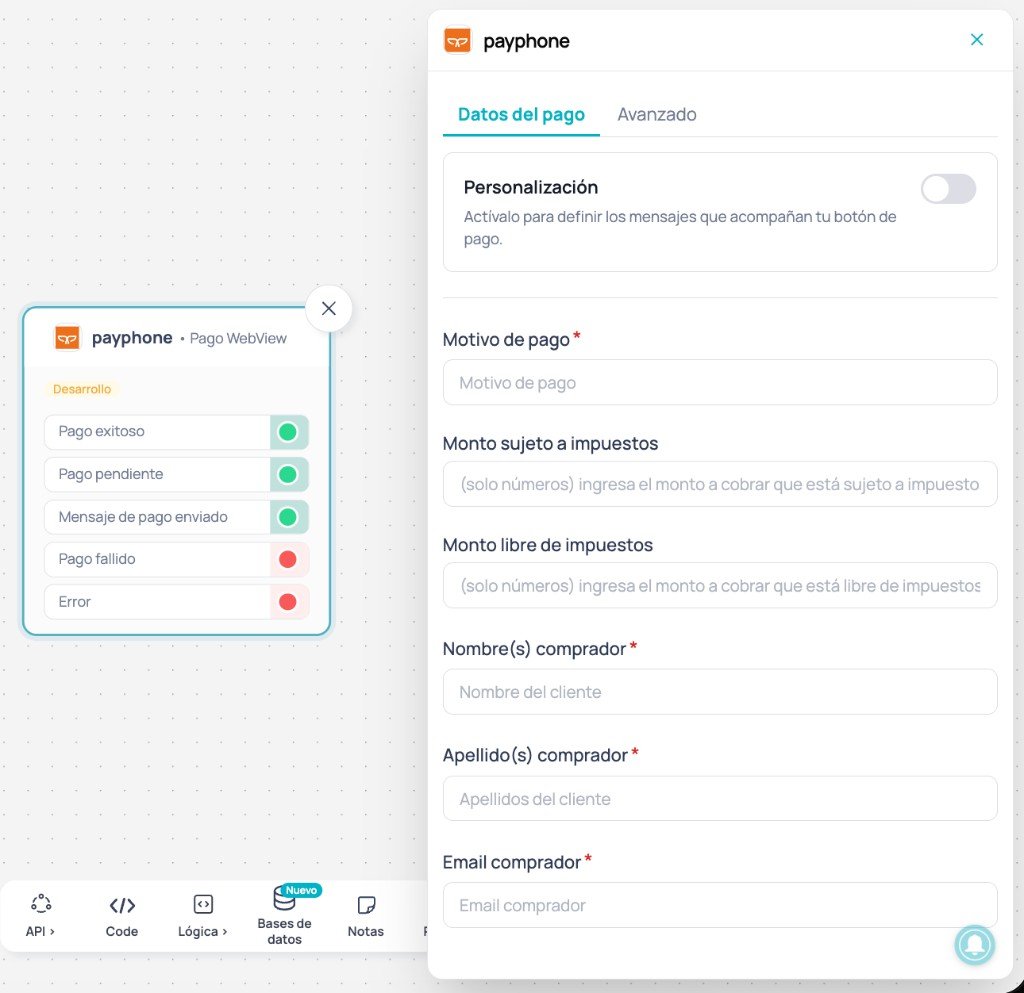
Payment data tab: personalization, amounts, and buyer details
Personalization
Personalization
boolean
default:"false"
Enable it to define the messages that accompany your payment button.When active, it enables Header, Body, and Footer fields.
Header
Header
string
Title of the payment button message.Shown when Personalization is active.
Body
Body
string
Main text of the payment button message.Shown when Personalization is active.
Payment reason
Payment reason
string
required
Descriptive text for the charge. Examples: order number, product, service, or internal reference.
Taxable amount
Taxable amount
number
required
Amount subject to VAT. Numbers only, in US dollars (USD).
Tax-free amount
Tax-free amount
number
required
Tax-exempt amount. Numbers only. If not applicable, use
0.Buyer first name(s)
Buyer first name(s)
string
required
Buyer’s first name for checkout.In Development, you can use test data. In Production, use the real name captured in the flow.
Buyer last name(s)
Buyer last name(s)
string
required
Buyer’s last name for checkout.In Development, you can use test data. In Production, use the real last name captured in the flow.
Buyer email
Buyer email
string
required
Buyer’s email for checkout.In Production, use the real email captured in the flow.
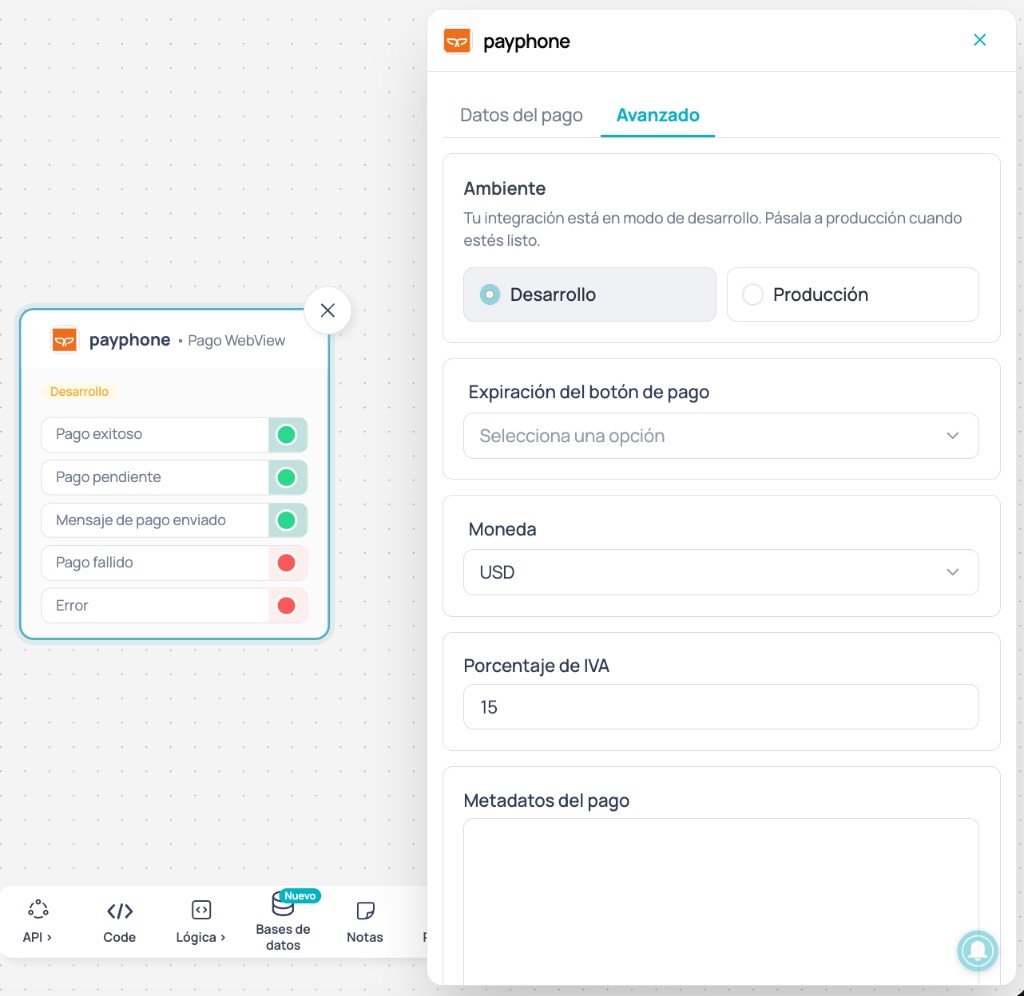
Node outputs
Outputs appear on the Payphone node in Canvas. Connect them based on the result you want to handle in your flow.Successful payment
Successful payment
Triggered when Payphone confirms the transaction was approved.Recommendations:
- confirm the order
- send receipt or notification
- update purchase status in your systems
Pending payment
Pending payment
Triggered when the transaction is in process or requires later confirmation.Recommendations:
- inform the user clearly
- avoid creating a second charge while the status is unresolved
Payment message sent
Payment message sent
Triggered when the payment button message is sent successfully in the conversation.This output does not confirm payment. It only indicates the payment button was sent in WhatsApp.You can connect this output to a post-send payment message support AI Agent to assist the user while they decide to open checkout or if they have questions before paying.Recommendations:
- answer questions about opening the payment button
- help if the WebView does not load
- do not confirm payments from this output
Failed payment
Failed payment
Triggered when the transaction was rejected, declined, or not completed.Recommendations:
- allow a controlled retry
- offer support or an alternate path
Error
Error
Triggered on technical errors, provider errors, or communication failures during payment creation or processing.Recommendations:
- log the error
- show a contingency message
- retry in a controlled way and escalate if it persists
Test payments
If Payphone is connected in test environment, validate the flow before going to production.In test mode, the charge depends on your Payphone Developer application being set to Test and the node showing Development environment. Payphone uses the same credentials in both scenarios.
1
Confirm environment in Brain Studio
Verify the integration was installed in test environment and the node shows Development in the Advanced tab.
2
Align Payphone Developer
In the Payphone Developer portal, select Test in your application’s environment selector.Review Obtaining credentials — Test and production mode.
3
Complete buyer data
In Payment data, enter Buyer first name(s), Buyer last name(s), and Buyer email with test data or flow variables.
4
Test from WhatsApp
Trigger the flow from WhatsApp, open the Payphone WebView checkout, and complete a test payment.
5
Validate flow output
Verify which output the flow continues through:
- Payment message sent (button send only)
- Successful payment
- Pending payment
- Failed payment
- Error
Go to production
If you installed Payphone in test environment, you can start going to production from the Payphone node’s Advanced tab in Canvas or from the Payphone page in Marketplace. The modal only asks for confirmation: current credentials are kept. Details in Connect in Brain Studio — Go to production. Before operating with real payments:- Switch your application in Payphone Developer to Production.
- Confirm VAT percentage and Currency (USD) on the node match your operation.
- Replace test data with real buyer data (first name, last name, email).
- Remember the $0.10 USD cost per production transaction, deducted from your Brain Studio balance.
- Run a low-amount real payment test before scaling.
Important considerations
Three points must align
Three points must align
For charges to work correctly, align:
- Installation environment in Brain Studio (test or production)
- Node environment (Development or Production)
- Test / Production selector in Payphone Developer
Same credentials always
Same credentials always
Token and Store ID do not change between test and production. Going to production in Brain Studio does not replace credentials; it only changes the operating mode.
Required buyer data
Required buyer data
Payphone requires buyer first name, last name, and email in Payment data. In production, use real data captured in the flow.
VAT and currency
VAT and currency
Applied VAT is defined at installation. The node’s VAT percentage must be consistent. Currency is USD.
Pending payments
Pending payments
If a payment is pending, inform the user and avoid starting a second charge until the status is resolved. The flow will continue through Successful payment or Failed payment when Payphone updates the result.
Next step
Coverage and pricing
Review availability, payment methods, and Payphone reference fees.